

In the high-stakes world of Australian industry, a label is more than just a sticker. It is a critical line of defense. Whether you are managing a remote mine site in the Pilbara or a heavy-duty manufacturing plant in Melbourne, your product labels must be designed right, built strong, and delivered on time.
Compliance isn’t a suggestion; it is a legal necessity. Failing to meet Australian Standards can lead to more than just fines, it can lead to equipment failure, site accidents, and compromised safety. This guide breaks down exactly how to create compliant product labels that outlast the elements and keep your site running smooth.
1. Understand the Standard: AS 1319-1994
In Australia, the "bible" for safety labeling is AS 1319-1994. This standard regulates the design and use of safety signs in the occupational environment. If your labels don’t match these specifications, they aren't compliant.
To stay on the right side of the law, you need to understand the four primary classifications of safety signs and labels:
- Prohibition Signs: These tell you what not to do. They must feature a red annulus (ring) and a slash over a white background.
- Mandatory Signs: These indicate that a specific action is required (like wearing PPE). These feature a blue circle with white symbols.
- Warning/Hazard Signs: These alert workers to non-life-threatening hazards. They use a yellow background with black text and symbols.
- Danger Signs: Used for life-threatening hazards. In Australia, unlike many international standards, Danger signs must never include pictograms. They feature a red oval inside a black rectangle with the word "DANGER" in white.
Using the wrong color or shape isn't just a design flaw; it’s a compliance failure. When you order Custom Safety Tags or Industrial Labels, ensure the provider understands these rigid Australian distinctions.

2. Choose Materials Built for Grit
Australia’s environment is brutal. Between the blistering UV radiation, torrential rain, and abrasive industrial grit, standard labels simply won't cut it. A label that fades or peels is a liability.
When selecting materials, you need to focus on three key traits: UV-stability, weather-resistance, and physical durability.
UV-Stable Polymers
Standard plastics crack and turn brittle under the Australian sun. For heavy-duty asset labels, you need UV-stabilized materials that resist fading. This ensures your safety warnings remain legible for years, not weeks.
Metal and Stainless Steel
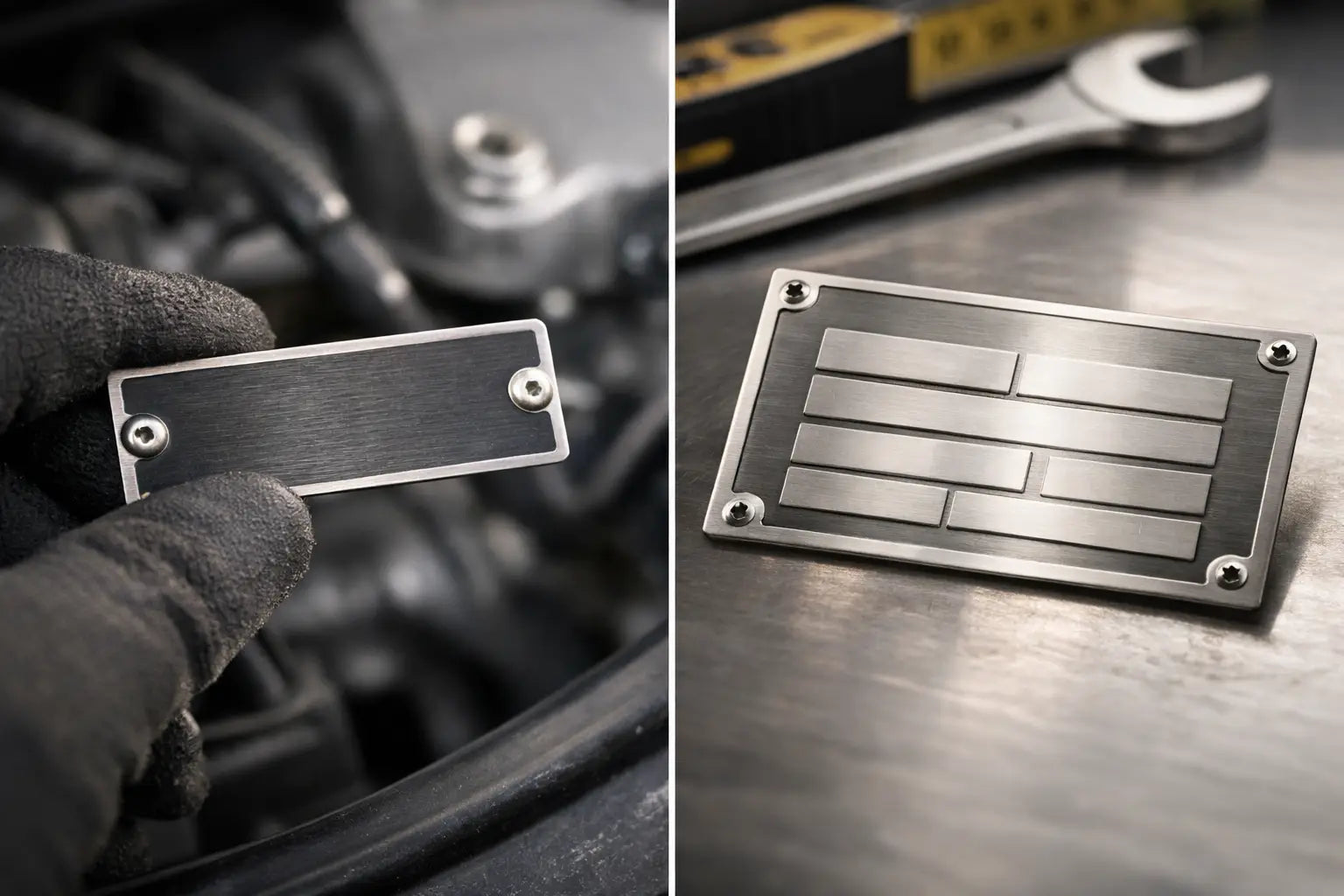
For the toughest environments, nothing beats metal. Stainless steel asset plates and Compliance Plates are the gold standard for machinery that faces extreme heat or chemical exposure. Laser-etched text won't rub off, and the material won't corrode.
High-Tack Adhesives
A label is only as good as the glue holding it on. Compliant industrial labels require high-tack adhesives designed to bond to low-energy surfaces like powder-coated metal and oily machinery. If it peels, it fails.

3. The Information Hierarchy: What Must Be Included
A compliant label must communicate effectively and immediately. Busy professionals on a site don't have time to decode a cluttered label. Your layout should follow a clear hierarchy of information:
- Signal Word: The header (DANGER, WARNING, CAUTION) must be the most prominent element.
- The Hazard: Clearly state what the danger is (e.g., HIGH VOLTAGE, CRUSH HAZARD).
- The Consequence: Briefly explain what happens if the warning is ignored.
- The Action: Tell the worker how to avoid the hazard (e.g., DISCONNECT POWER BEFORE SERVICING).
For asset management, Asset Plates should also include unique identifiers like QR codes or serial numbers to ensure 100% traceability. This makes audits and inspections faster and more accurate.
4. Layout and Visibility Best Practices
Visibility is the core of compliance. If a worker can't see the label from a safe distance, the label isn't doing its job.
- Font Choice: Use clean, sans-serif fonts like Helvetica or Arial. Avoid thin or decorative fonts that disappear under a layer of dust or grime.
- Contrast is King: Black text on a yellow or white background provides the highest legibility. Never use low-contrast combinations like red on black.
- Size Matters: The size of the text should be determined by the "safe viewing distance." AS 1319 provides specific formulas for this, but a good rule of thumb is: if you can't read it from 2 meters away, the text is too small.

5. Inspection and Maintenance
Compliance isn't a "set and forget" task. AS 1319 suggests that safety signs and labels be inspected at least quarterly.
During your site walk-throughs, check for the "Three Fs":
- Fading: Is the UV exposure washing out the red or yellow safety colors?
- Failing: Is the adhesive lifting at the corners?
- Filth: Is the label covered in grease or dust to the point of being illegible?
If a label shows signs of wear, it must be replaced immediately. We offer daily shipping Australia-wide to ensure your site never sits in a state of non-compliance while waiting for replacements. Check out our guide on AS/NZS 3760 standards for more on specific inspection requirements.
6. Why Local Manufacturing Matters
When you source labels from overseas, you're gambling with quality. Will the material stand up to the Western Australian sun? Is the adhesive designed for high-humidity coastal sites in Queensland?
At Prime Tags, our products are made with 100% Australian materials. We build them for Australia's toughest conditions because we know exactly what those conditions are. Plus, our Lowest Price Guarantee means you get compliant, heavy-duty solutions for 15% less than any competitor's price.

Final Checklist for Your Business
Before you hit "print" or place your next order, run through this checklist to ensure your product labels are fully compliant:
- Does it meet AS 1319 color and shape requirements?
- Is the material UV-stable and weather-resistant?
- Is the information clear, concise, and bold?
- Is the adhesive rated for your specific environment?
- Is there a plan for quarterly inspection and replacement?
Don't leave your site safety to chance. Whether you need Inspection Tags for your fleet or Flange Tags for a major shutdown, choose a partner that understands the grit of the industrial sector.
Prime Tags: Tough. Durable. Dependable.
Ready to secure your site? Contact us today for custom solutions tailored to your project needs.