
A faded asset label is easy to ignore until a technician cannot confirm the right unit, a service record goes missing, or an auditor asks for proof that equipment is correctly identified. That is where equipment identification labels stop being a small purchasing item and start affecting maintenance, compliance and day-to-day control across site.
On Australian worksites, labels do more than name an asset. They help teams track plant, match equipment to inspection records, confirm ownership, support shutdown planning and reduce errors in the field. If the label fails, the process around it usually fails as well. That is why material choice, print method and adhesive performance matter just as much as the data printed on the face.
What equipment identification labels need to do
At a basic level, equipment identification labels need to stay attached and stay legible. In practice, the requirement is broader. A label may need to carry an asset number, serial number, barcode, QR code, service class, location code or client-specific information. It may need to survive UV, washdowns, dust, chemical splash, abrasion or heat. In some environments, it also needs to remain readable after years of handling.
That is the difference between an office-grade sticker and an industrial identification solution. A standard label might look fine on day one. Out on a mine site, in a workshop or on mobile plant, day one is not the test. Six months of sun, grit and repeated cleaning is the test.
For buyers responsible for plant and compliance, the real question is not simply, “Will this stick?” It is, “Will this still be identifiable when we need it most?”
Why the wrong label creates bigger problems
Poor label performance rarely stays isolated to the label itself. Once information becomes unreadable or detached, asset registers become harder to trust. Maintenance teams lose time verifying equipment manually. Replacement schedules drift. Inspection histories become harder to match to the correct item. In regulated settings, that can quickly become a compliance risk.
There is also the cost issue. Cheap labels often create repeat orders, rework and labour waste. A label that needs replacing every few months is not cheaper once you factor in downtime, administration and site access. For high-volume assets or dispersed operations, that cost compounds quickly.
This is why experienced procurement and maintenance teams usually buy for service life rather than unit price alone. It is a more practical measure of value.
Matching equipment identification labels to the environment
Not every asset needs the same construction. Indoor switchboards, outdoor pumps, workshop tooling and transport equipment all place different demands on a label. Choosing correctly starts with the actual use case, not with the catalogue photo.
Outdoor and high-UV environments
Australian sun is unforgiving. Labels used on external plant, trailers, tanks, fire equipment enclosures or exposed infrastructure need materials and print processes built for UV resistance. If the face stock chalks, the print fades or the adhesive dries out, the label can become unreadable long before the asset reaches mid-life.
In these settings, durable synthetic materials and industrial-grade print options are usually the safer choice. Laminates can help, but only if the full construction is suited to the environment. A protective top layer cannot compensate for poor adhesive performance underneath.
Abrasion, grime and handling
Equipment that is touched regularly, dragged, washed down or exposed to grit needs more than weather resistance. Warehousing gear, lifting equipment, hoses, workshop assets and mobile plant often fail labels through abrasion before UV becomes the main issue.
Here, the trade-off is usually between flexibility and toughness. Some applications need labels that conform tightly around curved or textured surfaces. Others need rigid plates or heavier-duty constructions because a thin film label will simply wear through.
Chemicals, oils and washdown areas
Manufacturing, utilities and processing sites often expose labels to cleaners, solvents, oil mist and regular washdowns. Standard adhesives can soften or lift in these conditions, and some print methods will smear or break down. If the asset is cleaned as part of routine hygiene or maintenance, the label has to be selected with that cleaning process in mind.
This is one of the more common specification mistakes. Buyers may focus on the asset surface but not on what gets sprayed over it every week.
The data on the label matters too
A tough label is only useful if the information on it is clear and usable. That sounds obvious, but label layouts are often overloaded with text, tiny barcodes or inconsistent numbering structures that make scanning and field identification harder than it should be.
A good equipment label gives priority to the information your team actually uses first. In many cases that means a clear asset ID, a readable barcode or QR code, and enough supporting text to verify the item without crowding the face. If operators or contractors need to identify equipment quickly, legibility should beat graphic complexity every time.
Consistency also matters across fleets and facilities. If one site uses six-digit numbers, another uses mixed prefixes, and a third applies different naming conventions entirely, asset control gets messy. Labels work best when they support a disciplined identification system rather than trying to fix a disorganised one.
When labels are enough and when plates are better
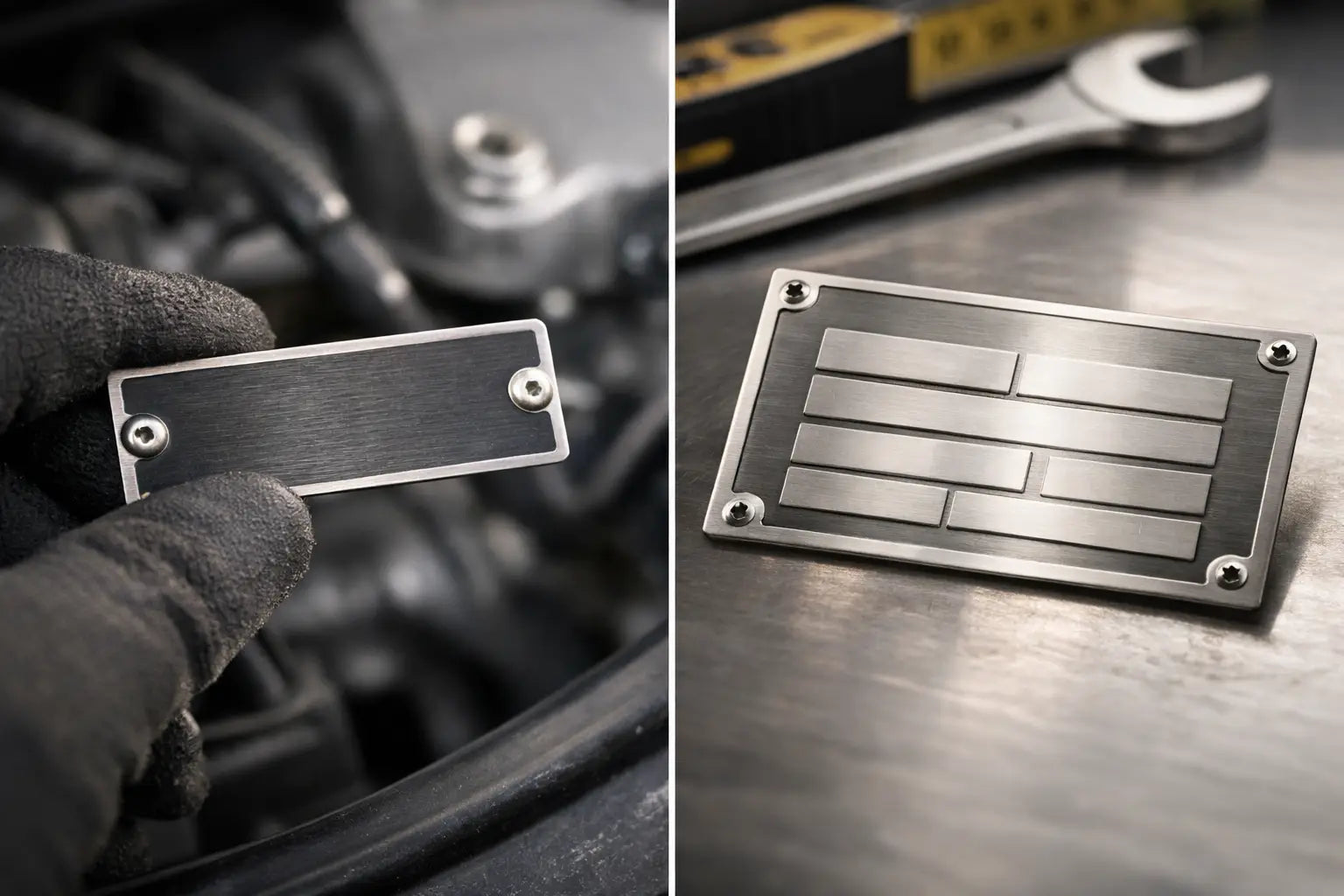
For many assets, equipment identification labels are the right answer. They are efficient, cost-effective and suitable for a wide range of surfaces and data formats. But there are situations where a metal plate or more permanent marking solution is the better fit.
If the asset has a long service life, faces heavy abrasion, or carries compliance-critical information that must remain intact for years, a plate may provide better durability. The same applies where the surface is rough, heat-exposed or likely to defeat adhesive performance.
It depends on the combination of environment, asset lifespan and compliance risk. A lower-cost adhesive label can be perfectly suitable for controlled indoor conditions. On heavily exposed plant, a more permanent option often makes better operational sense.
Customisation is not a nice-to-have
Industrial buyers rarely need off-the-shelf labels with generic text. Most sites require custom numbering, branding, barcodes, sequential data, department references, or asset classes aligned to internal systems. That is why customisation is not an extra feature. It is part of making the label useful.
The key is getting the custom work right without slowing the order down or introducing data errors. A supplier should be able to produce labels that match exact size requirements, substrate needs and variable data sets while keeping turnaround practical. If the custom process is clunky, procurement ends up carrying the burden.
For multi-site organisations, consistency across batches is just as important as the first run. The fiftieth label delivered six months later should match the first one in material, format and readability.
What to check before you place an order
Before approving a label specification, it is worth pressure-testing a few practical details. What surface is the label being applied to - powder-coated metal, raw steel, plastic, rubber or painted equipment? Is that surface smooth, curved or textured? Will the label be exposed to sun, pressure washing, chemicals or frequent handling? Does it need barcodes that scan from a mobile device, a warehouse scanner or both?
It also helps to think about application conditions. Labels applied in a clean workshop generally perform better than labels fitted outdoors on dusty equipment during a shutdown. If field application is likely, the adhesive and installation method need to allow for less-than-perfect conditions.
This is also the point to ask about samples. On-site testing is often the fastest way to avoid ordering a full run that looks right on paper but fails in practice.
Why local conditions should shape the spec
Australian conditions are not mild, and imported generic labels are often built for less demanding use. Heat, UV, coastal exposure, red dust, vibration and hard handling all shorten the life of low-grade identification products. For industrial sites, local suitability should be part of the buying decision from the start.
That is one reason many buyers prefer suppliers who understand Australian applications and manufacture for them directly. Prime Tags Australia, for example, focuses on worksite-ready identification products built from Australian materials for exactly these conditions. That matters when label failure creates more than a cosmetic problem.
Better labels make maintenance easier
The best labels do not draw attention to themselves. They simply keep working. Technicians can find the right asset, scan the right code, update the right record and move on. Procurement does not need to reorder replacements prematurely. Compliance teams have a clearer trail. Supervisors spend less time chasing identification issues that should never have existed in the first place.
That is the practical value of choosing well. Equipment identification labels are a small component in the budget, but they sit right in the middle of asset visibility, traceability and maintenance control. When the label holds up, the system around it has a far better chance of holding up too.
If you are reviewing labels across plant, tools, mobile equipment or site infrastructure, start with the harshest real-world condition the asset will face, not the neatest one. That is usually where the right choice becomes obvious.