
A trailer can be road-ready, workshop-finished and built to spec, but if the identification plate is wrong, unreadable or missing key details, you have a compliance problem on your hands. That is why trailer VIN plates Australia buyers order are not a minor add-on. They are a critical part of traceability, registration support and long-term asset identification.
For builders, repairers, fleet operators and compliance teams, the plate needs to do more than look correct on day one. It needs to stay legible after years of UV, road spray, grit, washing, handling and general hard use. In practice, that means material quality, engraving method, layout accuracy and supplier capability all matter more than a low upfront price.
What trailer VIN plates in Australia need to do
A trailer VIN plate identifies the trailer and carries the information needed for compliance, recordkeeping and inspection. Depending on the application, that can include the VIN, manufacturer details, date of manufacture, ATM, GTM and other build data. If any of that information is incomplete, poorly marked or hard to read, it can create delays during registration, handover, resale or audit.
For Australian conditions, the challenge is not just what goes on the plate. It is how well the plate performs once fitted. A plate mounted on a box trailer used occasionally around town faces a different environment from one fitted to plant trailers, heavy-duty equipment trailers or fleet units moving through remote and abrasive conditions. The compliance function is the same, but the durability requirement changes quickly.
That is where many off-the-shelf options fall short. A thin plate, weak print or unsuitable adhesive may look acceptable in the workshop, then fade, lift or wear out much earlier than expected. Replacing a failed plate is not just a nuisance. It creates extra admin, possible downtime and unnecessary cost.
Choosing trailer VIN plates Australia businesses can rely on
If you are sourcing trailer VIN plates Australia wide, the first question is not simply price. It is suitability for the job. A plate for a single custom trailer, a production run for manufacturers and replacement plates for an established fleet all call for slightly different support.
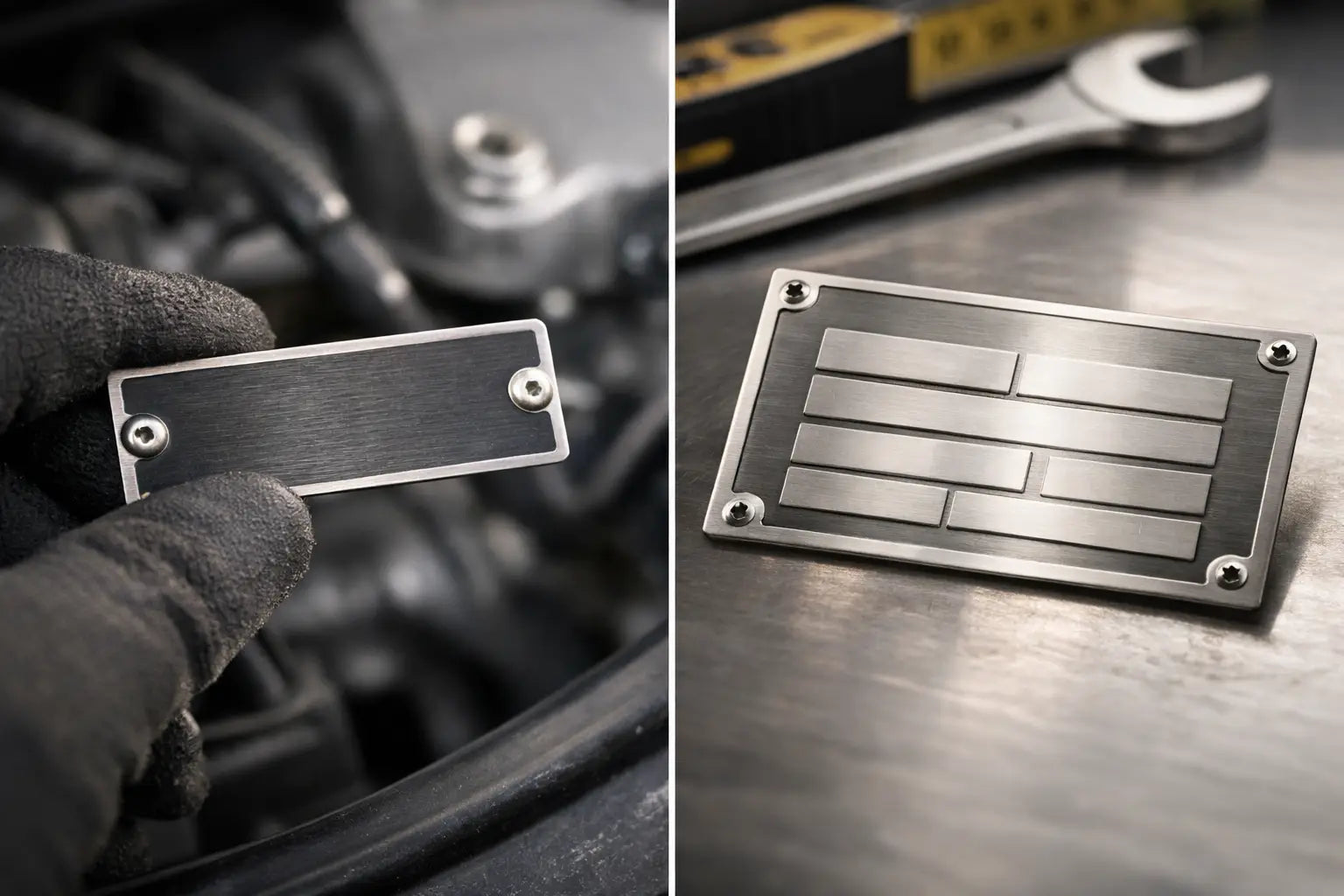
Material choice sits at the centre of that decision. Metal plates are commonly preferred for demanding environments because they hold up better under UV exposure, abrasion and weather. The finish also matters. A plate that keeps its markings clear after months and years outdoors is doing its job. One that becomes difficult to read under normal wear is a liability.
Marking quality is just as important. Clean, permanent identification is essential. If the text is too fine, too shallow or inconsistent across a batch, you are building problems into the process. Industrial buyers usually want a supplier that can produce plates with repeatable accuracy, especially when ordering in quantity or across multiple trailer models.
Lead time is another practical issue. Trailer production and handover schedules do not leave much room for compliance delays. If plates arrive late, the trailer may be finished but not ready to move. Fast turnaround matters, but not if speed comes at the expense of legibility or material strength. In this category, the best result is usually a supplier that can do both.
Compliance details that cannot be treated as an afterthought
A trailer VIN plate is only useful if the data on it is correct. That sounds obvious, but errors often happen when plate production is treated as a last-minute purchasing task rather than part of the build and compliance workflow.
Layouts should be clear and fit for purpose. Information needs to be easy to read, logically arranged and durable enough to remain legible over time. If you are ordering custom plates, it helps to work with a supplier that understands industrial identification products and can check that your required fields, sizing and production method suit the actual application.
There is also a practical difference between a plate that technically carries the information and one that works properly in the field. Small type, poor contrast or weak attachment methods can all create issues later. This is especially relevant for trailers used in transport, construction, agriculture, mining support and other sectors where equipment sees hard use and regular inspection.
It also depends on whether you are managing new builds or replacement requirements. New-build programs often need consistency across batches. Replacement jobs can be more complex because they may involve matching an existing format, fitting a limited mounting area or supplying lower quantities without blowing out lead time.
Why durability matters more in Australian conditions
Australian worksites are hard on identification products. UV exposure alone can shorten the life of lower-grade materials. Add heat, rain, mud, salt, pressure washing, vibration and dust, and a weak plate system will show its limits quickly.
That is why trailer VIN plates in Australia should be selected with local conditions in mind, not just basic appearance. A plate that performs in a mild indoor setting is not automatically suitable for road transport, civil works, regional operations or coastal environments. Buyers responsible for compliance-critical assets know this already. The cost of failure nearly always exceeds the cost of buying the right plate first.
There is a trade-off here. Not every trailer needs the heaviest-duty solution available, and over-specifying can add unnecessary cost. But under-specifying is the more common mistake. If the trailer is expected to spend years outdoors, travel regularly or operate in dirty and abrasive conditions, durable materials and permanent marking are the safer call.
For procurement teams, this is where supplier credibility becomes important. A supplier focused on industrial identification will usually have a better handle on exposure risks, material performance and production consistency than a generic print provider. That translates into fewer plate failures and less time spent fixing preventable issues.
Custom trailer VIN plates for different operational needs
Not every buyer needs the same plate format. Some need standardised trailer VIN plates that are straightforward, repeatable and fast to order. Others need custom sizing, branded layouts, serialised data or specialised plate configurations to suit a particular trailer type or internal asset process.
Customisation is valuable when it solves a real operational problem. That might mean fitting a plate into a restricted mounting position, aligning information fields with manufacturing records or ensuring visual consistency across a branded trailer fleet. It can also help workshops and manufacturers reduce handling errors by using a proven layout across repeat orders.
The key is keeping customisation practical. Too much variation can complicate production and increase the chance of data errors. The best custom plate programs are controlled, consistent and built around actual operational requirements rather than cosmetic preferences.
This is one reason many industrial buyers prefer dealing with an Australian supplier. Communication is simpler, turnaround is easier to manage and the product is more likely to be designed for local conditions from the start. For businesses that need dependable trailer VIN plates, Australia-based production can also make reorders and project changes less painful.
What to ask before placing an order
Before you commit to a supplier, it is worth checking a few practical points. Ask what material the plates are made from, how the data is marked, and how the product is expected to perform outdoors over time. Confirm what information needs to appear on the plate and how that data will be supplied and verified before production.
You should also look at minimum order quantities, especially if you need small runs, prototypes or replacements rather than volume production. Some suppliers are set up for large batches only. Others can support both short and long runs without making the process difficult.
If timing matters, ask about standard lead times and what happens when an urgent order comes through. Delays in identification products can hold up finished assets just as effectively as a delayed mechanical part. A supplier that understands production pressure is easier to work with when schedules tighten.
Prime Tags Australia fits this space well because the focus is not just on supplying a plate, but on supplying one that is built for hard use, tailored where needed and delivered without unnecessary back-and-forth.
Trailer VIN plates Australia teams should not have to replace early
A good trailer VIN plate does a simple job well for a long time. It stays attached, stays readable and supports the trailer’s compliance and identification needs without creating extra maintenance. That is what buyers should expect.
When you are comparing options, look past the sample photo and think about how the plate will perform after months on the road, in the yard or on site. If the product is built from suitable materials, marked clearly and supplied by people who understand compliance-driven industrial environments, you are far less likely to revisit the same problem in six months.
For most businesses, that is the real value - not just getting a plate made, but getting one that holds up when the trailer is out doing the job.