
A fleet plate that fades, lifts at the corners or becomes unreadable after one wet season is more than a presentation problem. It slows inspections, creates uncertainty around vehicle identity and specifications, and can leave maintenance teams chasing records that should be on the vehicle. The best compliance plates for fleet vehicles are built around the information your operation needs to prove, the surface they must stay fixed to, and the conditions they must survive.
For Australian transport, construction, mining and utility fleets, the right answer is rarely the cheapest generic label. A plate needs to remain legible through UV exposure, washdowns, road grime, vibration, heat and daily handling. It must also present clear, permanent information that supports registration, maintenance, asset control and site compliance.
Start with the plate's compliance job
Not every plate fitted to a vehicle carries the same legal or operational purpose. This distinction matters before choosing material, fixing method or layout.
A manufacturer or regulatory compliance plate may carry prescribed information relating to vehicle approval, identity, mass or build details. These plates must be produced and fitted in line with the applicable approval pathway, vehicle category and regulatory requirements. A fleet asset plate, service plate or operational identification plate may support internal controls, but it does not replace a legally required manufacturer plate.
For fleet operators, the common requirements usually fall into three areas: permanent vehicle identification, operating and specification details, and inspection or maintenance reference information. A light commercial ute may need a durable asset ID plate tied to its maintenance system. A trailer may require clearly presented VIN, tare mass and other build details. A specialised truck body may need a plate identifying equipment ratings, manufacturer details or load-related limits.
Before ordering, confirm exactly what information must appear, who is authorised to issue it, and whether a particular format or material is required. This small step prevents a costly remake or a plate that does not meet the job it was intended to do.
Best compliance plates for fleet vehicles: material choices
Material selection is where long-term value is decided. The best-looking plate on delivery day is not necessarily the best plate after two years on the road.
Anodised aluminium for most fleet applications
Anodised aluminium is a practical choice for many vehicle, trailer and plant identification plates. It is lightweight, corrosion resistant and well suited to detailed printed or engraved information. It can be supplied in different thicknesses and finished to suit riveted, screwed or adhesive fitment.
For general fleet asset identification, service information and vehicle specification plates, aluminium offers a strong balance of durability, readability and cost. It is especially effective where a plate needs to carry a logo, barcode, serial number, QR code or multiple lines of variable data.
The trade-off is application. Thin aluminium can deform if mounted to an uneven or heavily flexing surface, while poorly selected adhesives can fail on powder-coated, contaminated or textured panels. A mechanical fixing is often the better option for exposed locations.
Stainless steel for severe environments
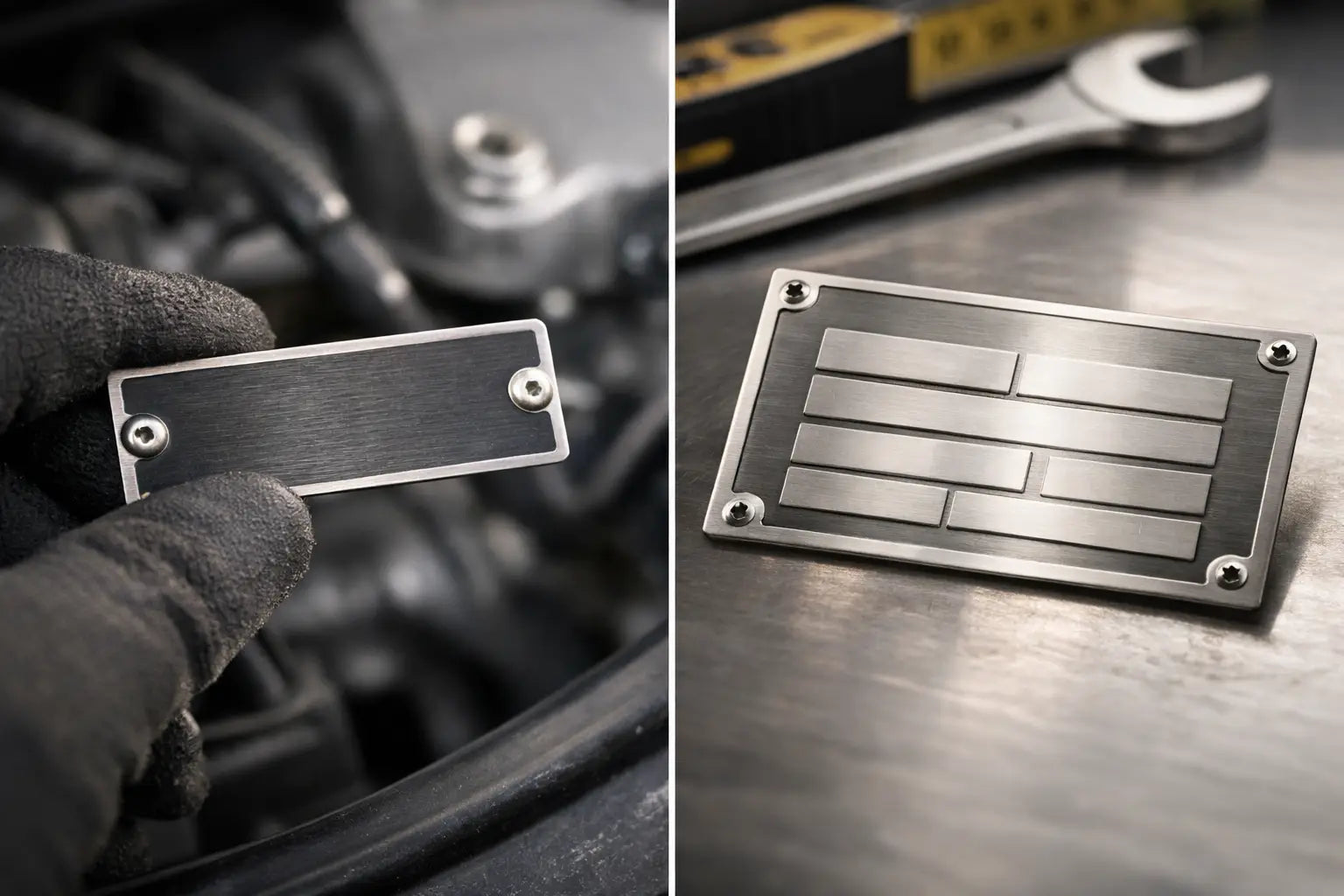
Stainless steel plates are suited to the harshest applications: coastal fleets, chemical exposure, high-temperature zones, abrasive environments and heavy industrial plant. They offer excellent corrosion resistance and tolerate hard service where lighter materials may become damaged.
They are a sensible choice for equipment mounted on truck chassis, trailers used near saltwater, waste vehicles, mining support fleets and plant exposed to grit or aggressive wash chemicals. Laser marking or deep engraving can provide highly permanent identification where legibility is non-negotiable.
Stainless steel costs more and takes more effort to fit than aluminium. It may be unnecessary for a protected cabin-door asset plate, but it is often a sound investment when plate replacement requires downtime, access equipment or workshop labour.
Flexible labels for protected, high-detail use
Industrial-grade polyester labels can work well for internal fleet information, inspection references, cab decals and barcoded asset tracking. They can carry fine print and variable data clearly, apply quickly and suit panels where a metal plate is impractical.
However, a label should not be selected simply because it is quick to apply. External exposure, rough handling, frequent pressure washing and curved or low-energy surfaces can shorten its life. Where the data is safety-critical, legally required or expected to remain with the vehicle for its service life, a metal plate is generally the safer choice.
Choose a fixing method that matches the surface
A plate is only as reliable as its attachment. Fleets often operate across mixed vehicle types, so one fitment method may not suit every application.
Mechanical fasteners, including rivets and tamper-resistant screws, are the dependable option for external plates, trailers, chassis-mounted equipment and high-vibration areas. They provide visible permanence and are less affected by dirt, heat and weather than adhesive alone. Use compatible fasteners to reduce the risk of galvanic corrosion, particularly when fixing aluminium plates to different metals.
High-performance adhesive can be effective on clean, smooth, properly prepared surfaces. It is useful where drilling is undesirable, such as painted bodywork, internal panels or areas near wiring and components. Surface preparation is critical: remove oil, dust, silicone and oxidation, then allow the adhesive to cure as specified before putting the vehicle back into service.
Avoid fitting plates where they will be hidden by accessories, damaged by tailgate movement, struck during loading, or exposed to direct spray from tyres. A practical location is accessible for inspection without creating an obvious damage point.
Make the information easy to inspect
A compliance plate is not a document archive. It needs to be read quickly, often in poor light, by someone standing beside a vehicle with a clipboard, mobile or scanner.
Use clear hierarchy. The vehicle identification number, asset number, serial number or key rating should be immediately visible. Secondary information such as manufacturer details, build date, model, mass data or inspection reference can sit beneath it in a clean, logical order. Avoid shrinking critical text to fit unnecessary branding or long internal descriptions.
Barcodes and QR codes can improve workshop and asset-management processes, but only when they are sized and printed for real-world scanning. A code that works from a computer screen may fail when dusty, scratched or scanned at an angle outdoors. Test it on the mobile devices and scanners your team actually uses.
For variable fleet data, a custom plate program is usually more efficient than manually marking blank plates. Consistent layouts reduce transcription errors and make replacements easier when a vehicle is transferred, rebuilt or reassigned.
Plan for the vehicle's full working life
The plate should be specified for the hardest part of its service life, not the cleanest part of its first month. Consider UV exposure, vibration, mud, washdowns, salt air, fuel splashes, temperature changes and physical contact from tools or loads.
Also consider what happens after repairs. Vehicle panels are repainted, truck bodies are modified and trailers are refurbished. If a plate needs to be removed for repair work, decide whether it will be replaced with identical data and how that replacement will be controlled. Keeping approved artwork and a verified data record makes this straightforward.
For fleet buyers managing multiple vehicle classes, standardising plate formats where possible brings real benefits. Technicians know where to look, procurement can hold consistent specifications, and auditors see a clear approach to identification. Standardisation should not override a regulatory requirement or an application-specific need, but it can remove unnecessary variation.
Questions to settle before ordering
A supplier can produce the right plate faster when the brief is complete. Provide the plate dimensions, material preference, required data fields, artwork, quantity, intended mounting surface and preferred fixing method. If the plate will carry regulated information, provide the approved wording and layout rather than relying on assumptions.
It is also worth requesting a sample or proof before committing to a larger fleet run. Check text size, contrast, barcode performance, hole positions and fitment against the actual vehicle or trailer. This is particularly valuable for custom plates with serialised data or multiple versions across a mixed fleet.
Prime Tags Australia produces custom compliance plates and industrial identification products using Australian materials selected for demanding local conditions. For fleet applications, the practical aim is simple: specify a plate that stays attached, stays readable and gives your team the information they need without delay.
The right plate is the one that still does its job after the kilometres, washdowns and workshop visits have added up. Put durability, clear data and correct fitment ahead of a marginal upfront saving, and your fleet will be easier to identify, maintain and inspect.