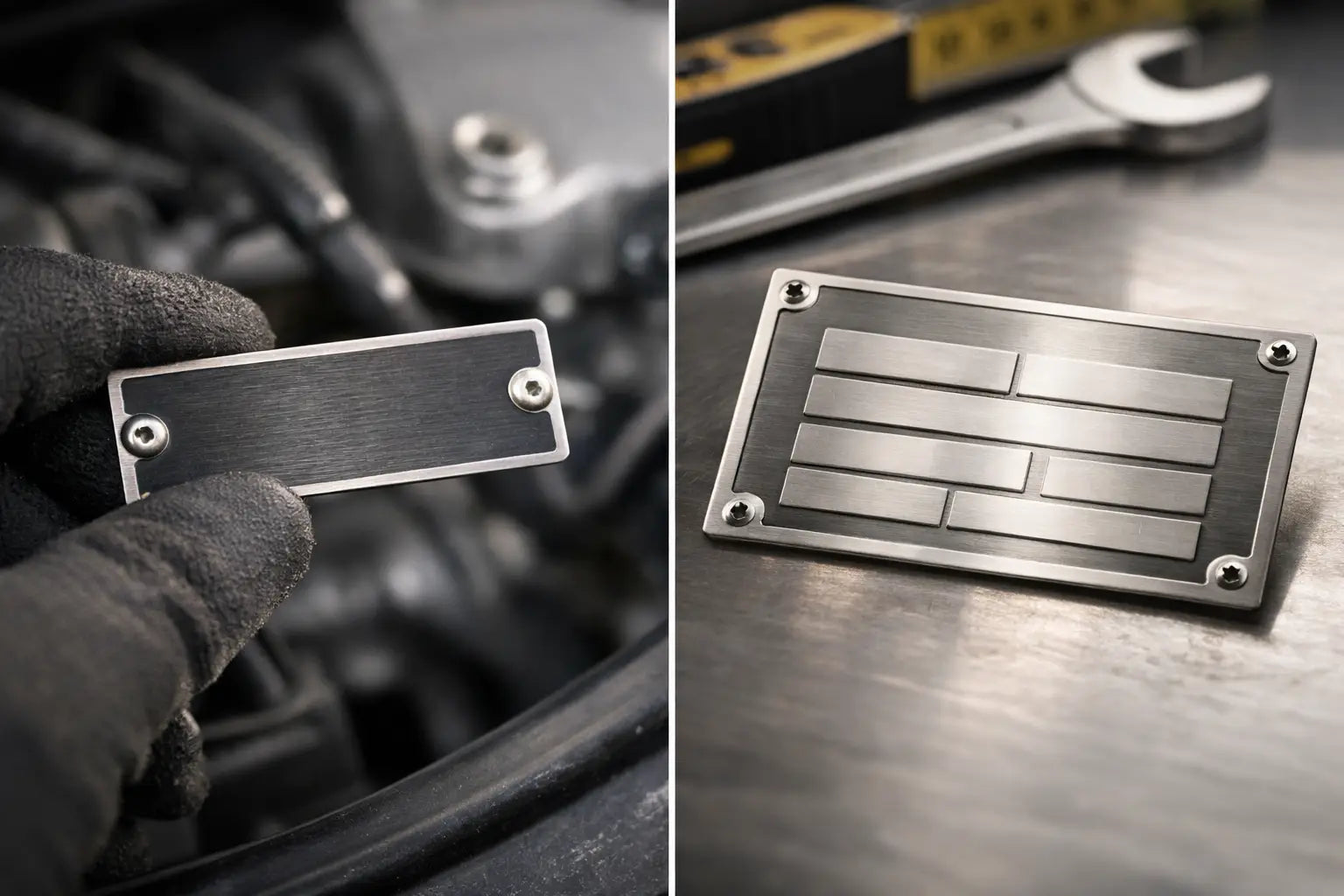

A faded asset label on a pump skid is not a minor issue when a technician is trying to confirm ID in dust, heat and poor light. That is where the real difference in engraved plates vs printed labels shows up. On paper, both mark equipment. On site, they perform very differently depending on exposure, compliance needs and how long the identification has to last.
For Australian industrial buyers, the right choice is rarely about appearance. It is about legibility after years of UV, abrasion, chemicals, washdowns and general site wear. It is also about whether the item needs permanent identification for compliance, traceability or inspection. Some jobs suit printed labels perfectly. Others need the staying power of an engraved plate.
Engraved plates vs printed labels: what changes on site?
The basic difference is straightforward. Engraved plates carry information cut into the material surface, usually on metal or durable laminate. Printed labels place the information onto the surface with ink, toner or thermal transfer printing on vinyl, polyester or similar stock.
That production difference matters because surface print is more vulnerable than recessed marking. If the environment is controlled, the label material is well matched, and the expected life is moderate, printed labels can be a practical and cost-effective option. If the marking must remain readable through years of wear, exposure or handling, engraved plates generally hold up better.
This is why industrial buyers should not treat them as interchangeable. A warehouse shelf label, a temporary inspection marker and a machine compliance plate do not face the same risks. Buying on unit price alone often leads to early replacements, rework and avoidable compliance headaches.
When engraved plates make more sense
Engraved plates are usually the stronger option where permanence is non-negotiable. They are well suited to asset identification, equipment data, compliance information, serial details and plant marking where the text needs to remain legible over the long term.
In harsh conditions, engraved plates offer a clear advantage. UV exposure can fade printed surfaces over time. Abrasion from grit, tools, cleaning and regular handling can wear through surface print. Solvents and aggressive cleaners can also shorten the life of some printed materials. By contrast, engraved text remains protected by being cut into the face, especially when paired with suitable industrial-grade materials.
That makes engraved plates a strong choice for mining, construction, manufacturing, transport yards, utilities and fire protection environments. They also suit equipment that is washed down regularly, mounted outdoors or exposed to heat and contaminants. If the identifier is expected to stay with the asset for most of its service life, engraving is often the safer call.
There is also a compliance angle. Plates used for machine data, VIN details, rating information or permanent asset records are often expected to present a professional, durable and tamper-resistant result. An engraved plate helps support that requirement because it looks fixed, deliberate and built for the job.
Strengths of engraved plates
The main strengths are durability, long-term legibility and a more permanent presentation. They are harder to damage accidentally and are less likely to fail just when the information is needed most. For businesses trying to reduce replacement cycles and avoid identity loss on critical assets, that matters.
Engraved plates also work well where the site standard demands consistency. Across a fleet, a workshop or a plant room, a permanent plate system can make identification cleaner and easier to manage over time.
Trade-offs to consider
Engraving is not automatically the best option for every application. It usually comes at a higher unit cost than printed labels, especially for simple short-life tasks. It can also be less flexible where information changes frequently. If the asset status, inspection period or internal coding is updated often, replacing engraved plates each time may not be efficient.
Attachment method matters too. Some plates need mechanical fixing, while others use industrial adhesive. The substrate, environment and installation process all need to be considered upfront.
Where printed labels are the better fit
Printed labels are often the right answer when speed, flexibility and cost control matter most. They suit high-volume identification, barcoding, inventory control, short-to-medium term asset marking and applications where data changes regularly.
A well-made printed label still has plenty of value in industrial settings. For indoor equipment, protected storage areas, controlled manufacturing spaces and lower-wear applications, printed labels can deliver clear identification without the cost of a plate. They are also useful where variable data is required at scale, such as sequential numbering, QR codes, batch information or frequent updates across a large asset register.
Printed labels are typically easier to roll out quickly. If a site needs hundreds or thousands of units, they offer efficiency in both production and application. They also suit curved or irregular surfaces better in some cases, especially where a rigid plate would be difficult to fit.
For procurement teams balancing budget and functionality, this is where printed labels earn their place. Not every item on site needs a permanent engraved solution. If the environment is moderate and the service life requirement is realistic, a quality printed label can do the job well.
Engraved plates vs printed labels for compliance
Compliance changes the decision. If the marking supports legal identification, equipment traceability, inspection records or required machine information, durability is not just a preference. It is part of risk control.
In those situations, ask a practical question: if this marking is damaged or unreadable in two years, what is the operational consequence? If the answer involves downtime, failed inspections, uncertainty around asset history or unnecessary replacement effort, an engraved plate is usually the stronger investment.
Printed labels can still play a role in compliance systems, particularly for supplementary information, internal tracking or scheduled replacement programs. But where permanent visibility is expected, the safer option is generally the one with the least chance of fading, scratching off or peeling away.
Australian conditions are a factor here. UV, heat, coastal air, dust and heavy use are hard on identification products. A compliance marker that performs well in an office or sheltered plant room may not last on a mobile asset, outdoor switchboard or exposed piece of equipment.
Cost is not just the purchase price
It is easy to compare engraved plates and printed labels on upfront cost, but that only tells part of the story. The better comparison is installed cost over service life.
A cheaper printed label that needs replacing multiple times can end up costing more in labour, downtime and administration than a plate that lasts. That is especially true on remote sites, high-access locations or equipment that cannot be taken offline easily. Re-identifying assets after labels fail also creates avoidable risk.
That said, overspecifying every identifier is not efficient either. Using engraved plates for temporary storage labels or frequently updated workshop tracking can waste budget. The smart approach is to match the product to the duty.
For many businesses, the best result is a mixed system. Use engraved plates for critical, long-life and compliance-related identification. Use printed labels where flexibility, variable data and fast application are more important.
How to choose the right option
Start with the environment. Will the item live outdoors, near chemicals, in washdown areas or in contact with abrasion and regular handling? If yes, engraving deserves serious consideration.
Then look at expected lifespan. If the identification needs to stay readable for years with minimal maintenance, a plate is often the better fit. If it only needs to last through a project cycle, stock turn or scheduled inspection period, a printed label may be enough.
Next, assess the purpose of the marking. Compliance and permanent asset identification call for a more durable solution than internal logistics or temporary tracking. Finally, think about data stability. Fixed information suits engraving. Frequently changing information often suits print.
This is where supplier capability matters. Material choice, adhesive selection, plate thickness, print method and application advice all affect performance. A tag or label is only as good as its match to the job.
For buyers who need dependable industrial identification, that means choosing products designed for local conditions rather than generic office-grade solutions. Prime Tags Australia works with Australian-made materials built for tough use, which is exactly what buyers need when failure on site is not an option.
The safest decision is usually the practical one. If the information must stay put and stay readable, choose the option built to last. If the application is flexible, short-term or high-volume, print may be the more efficient tool. Get that balance right and your identification system does its job quietly, year after year, without becoming another maintenance problem.