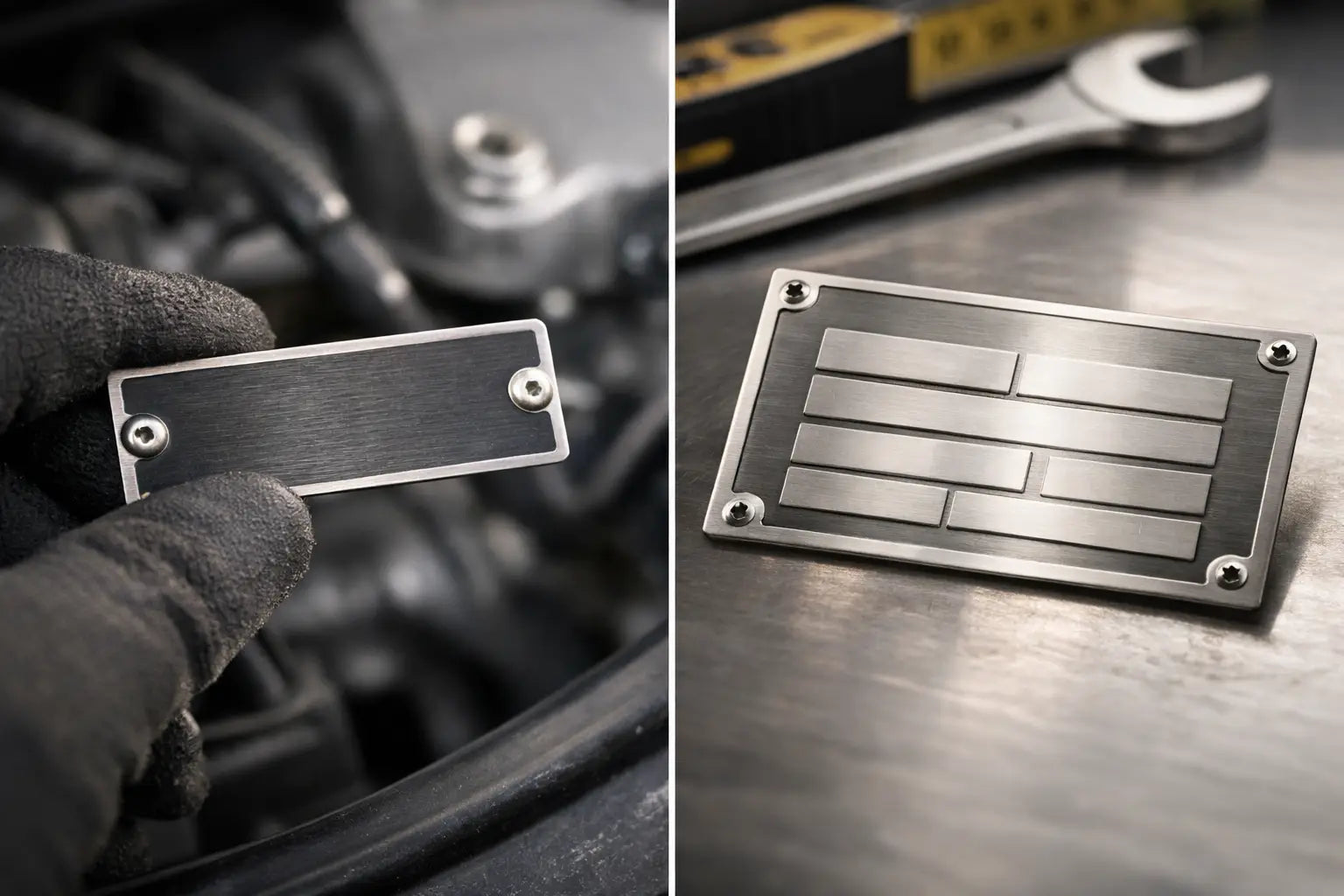

A builder plate is often the first place an inspector, operator or purchaser looks when they need to identify an asset quickly. Knowing what information belongs on builder plates prevents avoidable delays, supports traceability and gives the people using the equipment clear limits to work within.
For Australian businesses, the right details depend on what the plate identifies. A plate fitted to a trailer, pressure vessel, fabricated lifting frame, switchboard enclosure or piece of plant will not carry exactly the same information. The principle is consistent: the plate must identify the builder, identify the item and state the technical or compliance details needed for its safe and lawful use.
Start with the plate's purpose
Before choosing fields, establish what the plate needs to prove. A general manufacturer or builder plate identifies who made an item and when. A compliance plate may need prescribed information under the relevant law, approval process or industry standard. An equipment rating plate communicates operating limits, while an asset plate may simply support maintenance records and ownership control.
Trying to make one plate perform every job can create clutter and confusion. Where an item has separate legal compliance, operating and maintenance requirements, separate plates or labels are often the clearer option. The operator should be able to find the critical information without having to decode a crowded block of text.
Core information that belongs on builder plates
Most builder plates need a reliable set of identification details. These are the fields that establish the item's origin and allow it to be matched with drawings, certification, service records and purchase documentation.
Builder or manufacturer's details
Include the legal business name of the builder or manufacturer. Depending on the application, this may also include an Australian Business Number, contact details, logo or manufacturing location. The name should be the entity responsible for building the item, not merely the distributor that supplied it.
This detail matters long after installation or handover. If an asset needs replacement parts, engineering records, warranty support or confirmation of original specifications, a clear manufacturer identity gives the next person a starting point.
Unique identification number
Every significant asset should have a unique serial number, build number or identification number. This is the field that links the physical item to its paperwork. Avoid reusing numbers across similar units, even when they are produced in the same batch.
A serial number should be easy to read and permanently marked. If your maintenance system uses a different asset number, include that only if it will remain stable throughout the asset's working life. For fleets and high-volume equipment, a barcode or QR code can support faster scanning, but it should complement readable human text rather than replace it.
Model, type or description
State what the item is in practical terms. This could be a model number, equipment type, trailer type, assembly designation or description such as “lifting spreader beam”, “hydraulic power unit” or “custom steel access platform”.
A useful description distinguishes the asset from similar equipment on site. “Frame” is rarely enough. “Adjustable pipe support frame, 2 t WLL” is clearer and immediately more useful to a supervisor or inspector.
Date of manufacture
The month and year of manufacture are commonly included, and in some applications the full date is appropriate. This information helps establish the asset's age, supports inspection scheduling and assists with lifecycle planning.
For equipment subject to periodic inspection, the manufacturing date is not a substitute for an inspection tag or service label. It provides history, while the inspection system confirms current status.
Add the ratings that control safe use
Where the asset has a load, pressure, electrical, temperature or other operating limit, that rating needs to be explicit. This is where a builder plate moves beyond identification and becomes a practical safety control.
For lifting and rigging equipment, the working load limit must be prominent, unambiguous and expressed in the correct unit. For pressure equipment, relevant design or maximum allowable pressure and temperature information may be required. Electrical enclosures may need voltage, current, frequency, phase, ingress protection rating and other electrical data relevant to their design.
Do not use vague wording such as “heavy duty” where a defined rating is required. Nor should a plate show a capacity that differs from the engineering documentation or certification. If the asset has multiple configurations, state the capacity for each configuration clearly, or use a separate load chart where that is the safer and more practical format.
Include compliance details where they apply
Some builder plates require information set by legislation, approval conditions, standards or a client's engineering specification. This is particularly relevant for road-going trailers and vehicles, pressure equipment, lifting devices, electrical assemblies and fabricated plant used in regulated environments.
The exact requirements can vary by asset type, state or territory, date of manufacture and whether the item is built for sale, internal use or a specific project. For example, vehicle and trailer identification requirements may involve a vehicle identification number, aggregate trailer mass, gross trailer mass, tyre or axle details, and other prescribed particulars. The correct format should be confirmed before the plate is produced.
Where applicable, a builder plate may also show the relevant standard, design code, approval number, certificate number, drawing number, revision number or test pressure. Only include references that are accurate and current. Adding a standard number without confirming that the item meets the relevant requirements can create more risk, not less.
Design the layout for the worksite, not the office
A plate can contain correct data and still fail in the field if it is difficult to read. Group information logically: builder details first, then identification, then technical ratings and compliance references. Use clear labels such as “Serial No.”, “Date Manufactured”, “WLL” and “Maximum Pressure”.
Text size matters. Fine lettering may look neat on a proof, but it becomes hard to read when the plate is mounted low on a trailer, high on plant or exposed to dirt and glare. Keep critical ratings larger than secondary administrative details. Contrast is also essential, particularly where operators may be checking a plate outdoors in harsh Australian light.
Choose material and marking methods to suit the environment. A plate on indoor equipment has very different demands from one exposed to UV, salt air, wash-down chemicals, grit or vibration. Stainless steel, aluminium and durable industrial plastics each have a place, but the selection should match the application. Engraving, laser marking or deep mechanical marking can provide more reliable permanence than surface print where abrasion is expected.
Location and fixing are part of compliance
Fit the plate where it can be inspected without dismantling guards, opening covers or climbing into an unsafe position. It should be protected from routine impact where possible, but not hidden behind hoses, wiring or removable panels.
The fixing method must last as long as the plate. Adhesive can be suitable for clean, controlled surfaces and lower-risk applications, but rivets, screws or welded tabs may be more appropriate for mobile plant, trailers and heavy industrial equipment. A lost plate is not a minor cosmetic issue when it carries the only visible asset identity or operating limit.
Common builder plate mistakes to avoid
The most frequent problems are incomplete identification, unreadable text, unsuitable materials and copied information that has not been checked against the final build. A last-minute change to a capacity, drawing revision or component specification can make a pre-produced plate wrong before the asset even leaves the workshop.
Another common error is confusing a builder plate with a service tag. The builder plate records the item's original identity and design information. It does not show that a current inspection has been completed, that repairs are approved or that a lifting item is ready for use today. Keep those controls separate and make each one easy to understand.
For custom builds, have the final plate schedule reviewed by the person responsible for engineering, quality or compliance before production. Check spellings, units, serial number sequences, rating values and any standard or certificate references. This small step is considerably cheaper than replacing plates across a completed fleet or project.
A well-specified builder plate gives your asset a permanent, readable identity from day one. When the data is accurate, the layout is clear and the material is built for the environment, it supports safer decisions wherever the equipment ends up working.